
# Coding Business Adjustment: Where Do Developers Go?
# Coding Business Adjustment Details
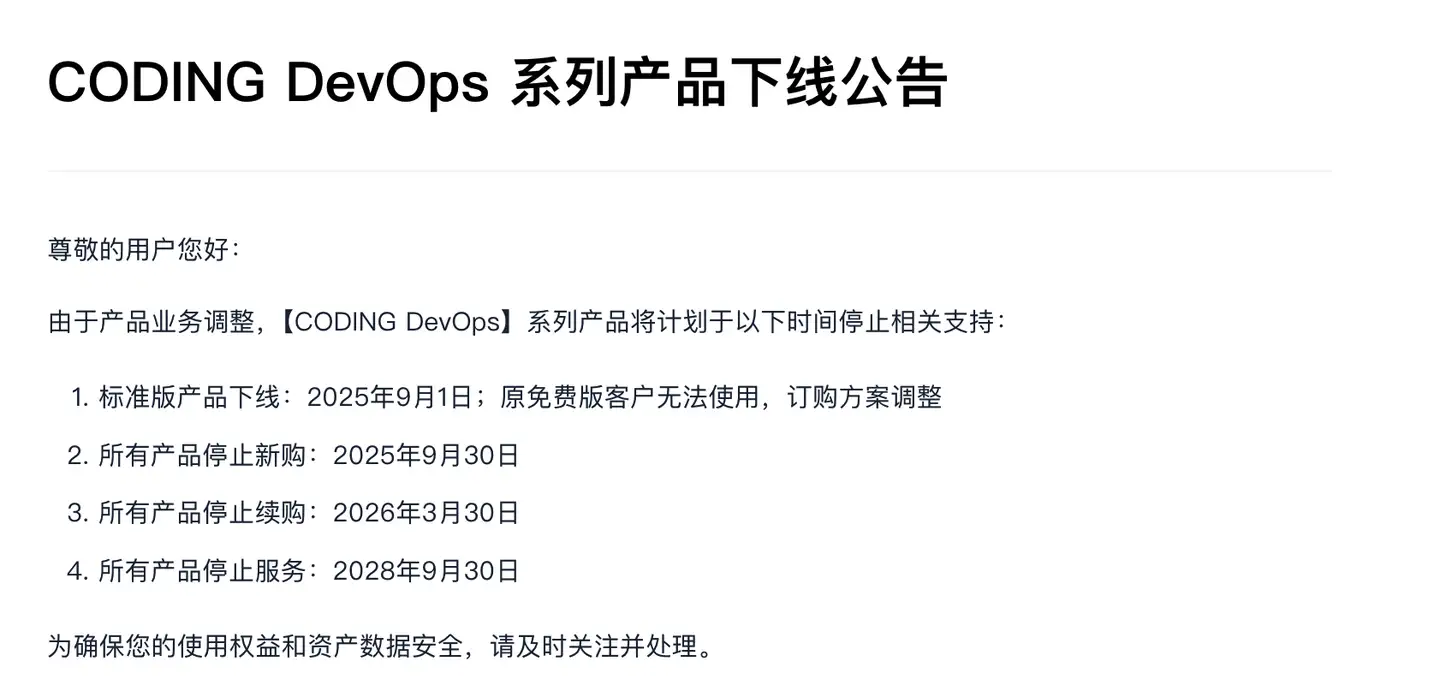
Recently, Tencent Cloud CODING platform announced major business adjustments: Starting September 1, 2025, CODING will cancel the original Standard Edition package and discontinue some core features (artifact security scanning, test management, test collaboration, dashboard, R&D metrics). New registered team users will no longer have continuous deployment and application management features in their interface. Meanwhile:
- September 1, 2025: Standard Edition officially discontinued, original Standard Edition users cannot log in and must upgrade to Advanced or Enterprise editions
- September 30, 2025: All products stop accepting new purchases
- March 30, 2026: All products stop renewals
- September 30, 2028: All products cease service
For small and medium teams and developers relying on CODING Standard Edition, this adjustment brings significant impact. Previously free or low-cost basic features will no longer exist, facing a dilemma between feature loss or cost surge.
# Zadig Public Welfare Assistance: Zero-Barrier Access to Open Source Alternatives
As an open source cloud-native DevOps platform, Zadig now launches the "Open Source Alternative Public Welfare Migration Plan" for CODING users, providing free assistance throughout the entire process from feature adaptation to technical support, with core advantages:
- Open Source Free Basic Capabilities: Basic version is open source and free, covering core scenarios like continuous integration and test management, directly replacing CODING Standard Edition features.
- 1:1 Feature Replacement: Complete support for CODING core capabilities, including blue-green deployment, canary release, automated testing, etc., while adding advanced features like AI environment inspection and multi-cloud management.
- Public Welfare Migration Support: Dedicated technical team providing free migration consultation, configuration debugging, and operational training to ensure smooth transition.
# Technical Compatibility Upgrade: Full-Chain Support for Tencent Ecosystem
Zadig deeply integrates with Tencent Cloud and ecosystem products, eliminating migration technical barriers:
- Seamless Integration with Tencent Cloud Suite: Native support for Tencent Cloud CVM (Cloud Virtual Machine), TKE (K8s cluster), TCR (Container Registry), COS (Cloud Object Storage), and other products, migration requires no architecture reconstruction.
- Multi-Cloud Deployment Flexibility: Besides Tencent Cloud, also supports Alibaba Cloud, Huawei Cloud, AWS, and 6 other major public clouds plus self-built K8s clusters, avoiding vendor lock-in.
# Zadig vs Coding Feature Comparison: Comprehensive Analysis
# Basic Feature Comparison
Zadig and Coding, as two mainstream DevOps platforms, have significant differences in core functionality. Here's a comparison of their basic features:
| Feature Module | Coding | Zadig |
|---|---|---|
| Continuous Integration | Supported, 1500 core hours/month | Supported, unlimited |
| Test Management | Cancelled in Standard, supported in Advanced | Full feature support, including automated testing |
| Artifact Management | Docker registry 5000 images | Supports multiple artifact types, integrates with multiple registries (including Alibaba Cloud ACR, Tencent Cloud TCR, Huawei Cloud SWR, Amazon ECR, Microsoft ACR, Google AR, DockerHub, Harbor, JFrog, Nexus, etc.) |
| Environment Management | Application-level environment management | Product-level environment management, supports multi-environment and heterogeneous |
| Deployment Strategy | Supports blue-green and batch canary deployment | Supports blue-green, canary, batch canary and other strategies |
| Efficiency Insights | Basic analysis features | Supports custom metrics and scoring weights |
| Access Control | Supports RBAC permission control | Supports both RBAC and ABAC dual permission control |
| Enterprise Customization | Not supported | Allows configuration of enterprise logo and custom system themes |
Key Differences: Zadig provides more comprehensive test management features, more flexible deployment strategies, and finer-grained permission control, especially suitable for medium to large teams and enterprises with high security compliance requirements.
# Cloud Native and Scalability Comparison
| Feature | Coding | Zadig |
|---|---|---|
| Cloud Native Support | Limited, partial cloud native features | Comprehensive cloud native architecture support, provides cloud native development environments |
| Multi-Cloud Support | Primarily Tencent Cloud ecosystem | Broad multi-cloud environment support, including Alibaba Cloud, Tencent Cloud, Huawei Cloud, GCP, AWS, Azure, etc. |
| Deployment Method | Mainly public cloud service, provides private deployment options | Primarily private deployment, supports K8s and host deployment |
| Scalability | Limited to Tencent Cloud ecosystem | Highly scalable, supports custom plugins and extension APIs |
| Automated Governance | Limited | Supports one-click governance of thousands of services through project templates |
Zadig's Cloud Native Advantages: Zadig not only supports cloud native development environments but also provides complete cloud native application management capabilities, helping enterprises quickly build modern software delivery systems. Meanwhile, its multi-cloud support ensures enterprises won't be locked into a single cloud vendor, improving architecture flexibility and portability.
# AI Empowerment and Automation Comparison
| Feature | Coding | Zadig |
|---|---|---|
| AI Features | AI Code Assistant CodeBuddy | Built-in AI environment inspection and efficiency diagnostic functions |
| Automated Testing | Limited | Supports automated test case management and execution |
| Automated Deployment | Basic support | Comprehensive automated deployment pipeline support with multiple deployment strategies |
| Efficiency Analysis | Basic metrics | AI efficiency diagnosis can intelligently analyze efficiency data and quickly locate bottlenecks |
| Anomaly Detection | Limited | AI environment inspection enhances automatic anomaly detection capabilities for Kubernetes environments |
Zadig deeply integrates with AI models like DeepSeek, providing powerful AI environment inspection and efficiency diagnostic functions that help teams quickly identify and solve problems in the development process, improving overall efficiency.
# Migration Value: From "Emergency Replacement" to "Efficiency Upgrade"
Migrating to Zadig, R&D teams can gain the following best practices and benefits:
# Cloud Native Development Practices
Zadig fully leverages cloud native advantages, supporting the following best practices:
Microservices Architecture Support:
- Use Zadig's multi-service parallel build functionality to improve microservice development efficiency
- Leverage template library features to quickly create standardized microservice configurations
- Implement service-level independent deployment and rollback, reducing change risks
Environment Isolation and Management:
- Create multiple isolated environments including development, testing, pre-production, and production
- Use environment variables and configuration management to ensure configuration consistency across different environments
- Utilize Zadig's environment template features to quickly create standardized environments
Containerization Best Practices:
- Use Dockerfile templates to create standardized container images
- Implement container image security scanning and vulnerability detection
- Leverage Zadig's cloud native build functionality to optimize container build processes
# Automated Testing and Quality Assurance
Zadig supports comprehensive automated testing strategies:
Shift-Left Testing Practices:
- Execute unit tests and static code analysis at code commit stage
- Use Zadig's pre-validation functionality for automated testing before merge requests
- Implement continuous testing to ensure continuous code quality improvement
Test Parallelization:
- Group and execute test cases in parallel to shorten testing cycles
- Leverage Zadig's parallel testing capabilities to support thousands of test cases running in parallel
- Implement rapid creation, destruction, and hibernation of test environments to improve resource utilization
Test Data Management:
- Use Zadig's environment management functionality to provide consistent datasets for testing
# Continuous Delivery and Release Management
Zadig provides powerful continuous delivery and release management capabilities:
Blue-Green Deployment and Canary Release:
- Implement blue-green deployment to ensure service continuity
- Use canary release and batch canary release strategies to reduce release risks
- Leverage Zadig's full-chain canary release functionality for fine-grained release control
Automated Release Pipelines:
- Create end-to-end automated release pipelines
- Implement event-based trigger mechanisms like code commits, scheduled triggers, etc.
- Utilize Zadig's workflow functionality to implement complex release logic
Rollback Strategies:
- Implement one-click rollback functionality to ensure rapid configuration recovery
- Leverage Zadig's version management functionality to easily manage application versions
- Implement pre-release checks to reduce rollback requirements
# Efficiency Analysis and Continuous Improvement
Zadig provides comprehensive efficiency analysis capabilities supporting continuous improvement:
Data-Driven Decision Making:
- Leverage Zadig's efficiency insights functionality to collect and analyze development process data
- Customize efficiency metrics and scoring weights for precise analysis of business efficiency bottlenecks
- Implement regular efficiency assessments and improvement plans
Automated Monitoring and Alerting:
- Configure monitoring and alerting for key metrics
- Leverage Zadig's AI efficiency diagnostic functionality to automatically identify performance bottlenecks
- Implement anomaly detection and automatic recovery mechanisms
# Migration Action Guide: Three Steps to Smooth Transition
# Migration Preparation
Before starting migration, complete the following preparation work:
Join Zadig Public Welfare Assistance Group:
- Join Zadig migration support group for free technical consultation and migration guidance
- Discuss migration solutions and best practices
Evaluate Existing Systems:
- List all Coding features and services being used
- Assess usage frequency and importance of each feature
- Identify workflows dependent on Coding-specific features
Environment Preparation:
- Install and configure Zadig environment, choose local deployment or cloud server deployment
- Integrate necessary third-party services like code repositories, image repositories, etc.
- Prepare accounts and permissions needed for migration
Data Backup:
- Backup important data from Coding, including code, configuration files, build logs, etc.
- Export test cases, bug reports, and other project management data
Team Training:
- Organize team members to attend Zadig training courses to understand Zadig for quick onboarding
- Establish internal support channels to answer questions during migration
# Configuration Migration
Migrating workflows and environment configurations is a critical step:
Build Configuration Migration:
- Create build configurations for each service in Zadig
- Copy build scripts from Coding and make necessary adjustments
- Configure code sources, build environments, and build parameters
Workflow Migration:
- Analyze workflow logic and trigger conditions in Coding
- Create corresponding workflows in Zadig
- Configure triggers such as Git commits, Pull Requests, and other events
Environment Configuration Migration:
- Collect environment configuration information from Coding
- Create environments in Zadig and configure related services and variables
Permissions and Roles Migration:
- Analyze permission settings and role assignments in Coding
- Create corresponding user groups and permission policies in Zadig
- Batch import users and assign appropriate permissions
# Testing and Validation
After migration completion, comprehensive testing and validation must be performed:
Functional Testing:
- Verify all core functions work properly
- Test deployment and rollback processes in different environments
- Check execution results of automated test cases
Performance Testing:
- Test if build and deployment performance meets requirements
- Verify stability of large-scale concurrent builds
- Monitor Zadig's resource usage to ensure stable system operation
Integration Testing:
- Verify integrations with third-party services work properly
- Check if permission controls and security policies are correctly implemented
# Action Recommendations
# For Technical Leaders
Evaluate Promptly:
- Assess impact of Coding feature adjustments on existing systems
- Develop detailed migration plans and timelines
- Determine migration priorities and key milestones
Phased Migration:
- Prioritize migration of core services and critical workflows
- Gradually migrate testing and quality assurance systems
- Finally optimize and complete full transition
Invest in the Future:
- View migration as an opportunity to enhance DevOps capabilities
- Adopt cloud native best practices to build modern software delivery systems
- Invest in automation and AI capabilities to improve team efficiency
# For Enterprise Decision Makers
Budget Planning:
- Evaluate migration budget and long-term costs
- Consider licensing costs for Zadig Expert or Enterprise editions
- Reserve training and consulting budget to ensure smooth migration
Resource Allocation:
- Allocate sufficient technical resources to support migration
- Ensure business continuity during migration period
- Plan long-term technical architecture and tool investments
Value Realization:
- View migration as investment in improving R&D efficiency
- Set clear ROI targets and evaluation metrics
- Continuously monitor technology trends to maintain competitiveness
# Join the Public Welfare Migration Plan Now
"We don't just provide alternative solutions, but help teams complete DevOps capability upgrades during migration" —— Zadig Customer Success Team
Facing CODING service adjustments, Zadig provides sustainable solutions with the power of open source ecosystem. Regardless of team size, support can be obtained through the following methods:
- Scan QR code to join public welfare support group for dedicated migration advisor services
- Visit Zadig official website (https://koderover.com), click "Enterprise Consultation" at the bottom of the page, and explain your intention to get migration support

This public welfare migration plan will continue until September 1, 2025, helping every affected developer team transition smoothly and embrace a more open, efficient DevOps future.
Take action now, seize the DevOps upgrade opportunity, and start an efficient, flexible, and intelligent software development journey!


